

Status Match as a strategic weapon. What can loyalty programme marketers learn from Virgin’s offensive aimed at BA customers?
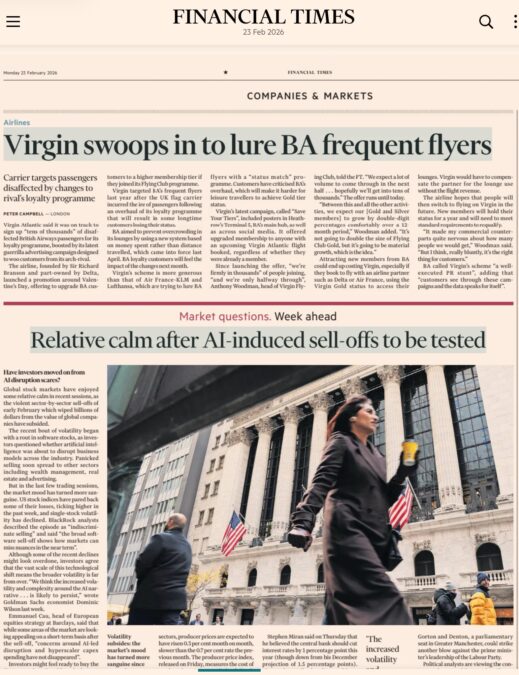
On 23 February 2026, the US edition of the Financial Times published an article titled Virgin swoops in to lure BA frequent flyers, which inspired the following text. In mature aviation markets, acquiring a new customer is difficult and poaching awa your competitor’s high-value customer is even more difficult. This makes the move by Virgin Atlantic, which recently launched an aggressive campaign targeting British Airways passengers who are members of BA’s loyalty programme, all the more interesting. The key tool here is neither the classic price promotion nor the mileage bonus, but the status match mechanism – one of the most underrated instruments in the loyalty marketing arsenal.
For experts in loyalty programme design, this situation is an interesting case study: it shows how changes in the structure of one player’s programme create an acquisition opportunity for another, and how status – rather than reward – becomes the main currency of competition.
Background of the market events
Virgin does not operate in a vacuum. The campaign has been launched at a time when British Airways is introducing significant changes into its loyalty programme. One of the most important is the shift from a status qualification model, based mainly on distance and number of flights, to a system more strongly linked to actual amounts spent.
Such changes have several consequences:
- Some existing customers are losing their relative status advantage – especially passengers who fly frequently but in lower fare classes.
- Perception of the programme’s value is shaken – even if objectively the offer is not worse.
- A moment of “psychological openness” to changing the supplier emerges.
It is precisely this moment that Virgin is seizing, offering BA passengers the opportunity to quickly achieve equivalent or similar status in their own programme.
For loyalty marketers, it’s a reminder of a fundamental principle:
the best time to take over a competitor’s customer is when the competition changes the rules of the game.
What is Status Match all about?
Status Match involves awarding a customer a certain level in the loyalty programme based on the status held with a competitor. In practice, this means that a passenger with a high status in one programme can “transfer” part of their preferential treatment to another ecosystem.
Why is this such a powerful tool?
1. Get rid of the biggest barrier to change
The biggest obstacle to premium customer migration is not the price, but the loss of status: lounge access, priority boarding, extra baggage or preferential service. Status Match neutralises this barrier immediately.
2. Targeting high-value customers
High-status clients are typically:
- people who travel frequently,
- decision-makers in companies,
- customers with a high Lifetime Value.
A loyalty programme does not need to run an extensive acquisition campaign – it is enough to identify the competitor’s premium segment precisely.
3. Low unit cost
Unlike classic mileage promotions or cashback, the cost of a status match is largely conditional. The benefit only materialises once the customer actually starts using the service.
Virgin: an example of a status-driven offensive
Virgin’s strategy has several distinctive elements that are of particular interest from a loyalty campaign design perspective.
Extensive communication
The campaign was launched simultaneously across social media, PR communications and own channels. This is not a niche action aimed solely at existing customers – it’s a public signal to the market.
In practice, this means:
- increased image pressure on competitors,
- building brand perception as an “alternative to the disillusioned”.
Rapid programme entry process
One of the key elements behind the effectiveness of Status Match is the minimisation of friction in the application process. The less paperwork, the higher the conversion rates.
The best programmes today use:
- status verification based on screenshots or digital cards,
- rapid decisions (often within 24-72 hours),
- immediate activation of benefits.
Conditional retention of status
Often, Status Match is granted on a temporary basis and its retention is dependent on completing a certain number of flights or achieving a minimum level of spending within a certain period.
This mechanism is of dual purpose:
- it limits the programme’s cost,
- it motivates the client to transfer their activities quickly.
Loyalty programmes as an area of strategic competition
For many companies, the loyalty programme is still mainly seen as a retention tool. However, in the aviation industry, it has had a much greater strategic role for years: it is a platform for competitive struggle.
The Virgin case highlights three important trends.
1. Status becomes more important than points
For premium customers, the value of points or miles is often secondary. Status infrastructure is key:
- lounge access,
- priority procedures,
- flexibility of booking changes,
- premium service.
This means that the design of loyalty programmes more and more often resembles the management of a privilege system, rather than just the economics of points.
2. Loyalty programme as an acquisition tool
Traditionally, programmes have been designed primarily with customer retention in mind. However, more and more often they are becoming an instrument for active acquisition.
Status Matches, points transfers or coalition partnerships allow competitors to attract customers in a more subtle way than aggressive price promotions.
3. War for the premium segment
In many industries – from aviation to banking or hospitality – a small group of customers generates a disproportionate share of revenue. Loyalty programmes are therefore becoming a tool for selective competition for this segment.
Lessons for loyalty programme designers
From the perspective of marketers designing loyalty programmes, the Virgin case can be boiled down to a handful of practical conclusions.
1. Monitor changes in competitors’ programmes
Changes to status thresholds, benefit structures or eligibility rules can generate acquisition windows. Pre-prepared reactive campaign scenarios could prove useful.
2. Treat status as a product
Status in a loyalty programme holds real market value. It should be managed as it were a product:
- define target segments,
- manage accessibility,
- design upgrade paths.
3. Design onboarding of competitors’ customers
Status Match is just the beginning. The key is whether the customer will actually transfer their behaviour.
Best practices include:
- dedicated welcome messages,
- bonuses for first transactions,
- allowing to rapidly experience status benefits.
4. Manage benefit costs
Loyalty programmes often overestimate the cost of premium privileges. In fact, many have a low marginal cost, especially if the infrastructure is already in place (e.g. a lounge).
Therefore, a well-designed status match can have very attractive economics.
Is Status Match the start of a wider range of activities?
The history of the airline industry shows that aggressive Status Match campaigns can set off a chain reaction. Competitors are responding with their own offers, and premium customers are beginning to actively “arbitrage” between programmes.
From a market perspective, this could lead to two scenarios:
- benefit escalation, with programmes competing with increasingly attractive benefits,
- tighter eligibility thresholds to reduce costs.
Whatever the direction, one thing is clear: loyalty programmes are no longer just a marketing add-on. They have become a key element of competitive strategy.
Status Match in practice – case studies from other markets
The Status Match mechanism did not originate from the aviation sector – although that is where it has reached the highest level of sophistication. Over the past decade, it has moved into the hospitality industry, casinos, car rental and, albeit on a smaller scale, the financial and telecommunication sectors. Each of these industries has developed its own approach, tailored to the specifics of the market, the value of the premium customer and the cost structure of the perks offered. The following case studies illustrate how different industries use Status Match as a tool for acquisition, retention and building loyalty ecosystems.
Case study 1: Marriott Bonvoy and United Airlines – RewardsPlus Status Match as a sustainable strategic partnership (US market)
One of the most mature examples of the institutionalisation of Status Match is the RewardsPlus programme, linking the Marriott Bonvoy hotel chain with United Airlines. As part of this partnership, United MileagePlus members at the Premier Gold level and above are automatically granted Gold Elite status at Marriott Bonvoy, while Titanium Elite or Ambassador Elite status holders at Marriott Bonvoy are granted Premier Silver status at United MileagePlus.
What is unique about this model is that Status Match is not a one-off acquisition campaign, but a permanent, renewable element of the architecture of both programmes. The client can renew benefits each year by registering in the system – as long as they continue to meet the status thresholds. Such a model eliminates the cost of repetitive marketing campaigns and builds a sense of permanence in the relationship.
From an economic perspective, the Marriott-United partnership is an example of a so-called “soft cross-sell”: an airline customer who has never been a Marriott customer before gets an instant password to the hotel ecosystem. Studies of member behaviour indicate that those using both programmes at the same time show a statistically higher Customer Lifetime Value than members active in only one. Both brands also see this partnership as part of their defence against the competition: a customer pinned to two premium ecosystems at the same time is less susceptible to Status Matches from rivals.
Also worth noting is the mechanism to protect the quality of the matched status – the programme excludes clients from the partnership who originally obtained their status through Status Match or promotion rather than organic qualification. This is a sign of design maturity: RewardsPlus only targets customers who have proven a high level of travel/hotel activity.
Case study 2: American Airlines and World of Hyatt – Status Match as a loyalisation tool at the intersection of aviation and hospitality (global market)
American Airlines’ AAdvantage partnership with the World of Hyatt hotel programme is an example of one of the most sophisticated status match mechanisms in the global travel loyalty market. Its uniqueness lies in the linking of status migration to the points system – the internal currency of the AAdvantage programme, which can be accumulated not only through flights, but also through credit card purchases, purchases in the partner network or the use of partner services.
In practice, it works as follows: AAdvantage members who accumulate 100,000 points in a qualification year can achieve Discoverist status at Hyatt; 175,000 points give access to Explorist status; while Concierge Key members – the highest tier of AAdvantage – can apply for Hyatt Globalist. Reciprocally, Hyatt elites can participate in 90-day status challenges in the AAdvantage programme.
Strategically, the Hyatt-AA partnership demonstrates a higher level of status match evolution: instead of a one-off status exchange, a sustainable infrastructure has been created to motivate customers to be active in both ecosystems simultaneously. An AAdvantage customer who actively uses Hyatt naturally increases their spending profile in both programmes, and the Loyalty Points mechanism makes just having an AAdvantage credit card a potential stepping stone to hotel status. This is an example of how match status has evolved from a one-off acquisition tool into an architecture for long-term engagement.
Case study 3: Best Western Rewards “Status Match… No Catch” – match status as an ongoing programme policy (global market)
While most hotel programmes treat status match as occasional, time-limited campaigns, Best Western Rewards has opted for a radically different approach: it has made status match a permanent, overt element of its value proposition. The programme is called ‘Status Match… No Catch’ – and the name reflects the design philosophy perfectly.
Any traveller with elite status in another hotel programme can request a status adjustment by sending confirmation to [email protected]. The answer is promised quickly, and the status is valid until the end of the programme year – and in 2026 even until the end of 2027. There are no overnight stay requirements during the test period. There are no limits or complicated online forms.
Best Western’s strategy is an expression of thinking about Status Match as a market positioning instrument, not just short-term acquisition. The Best Western chain has more than 4,500 hotels in nearly 100 countries and its portfolio is seen as a mid-range segment, not necessarily the first option for elite Marriott or Hilton customers. “Status Match… No Catch” gives these customers the impetus to try Best Western properties when travelling where their preferred chain does not have a suitable location. This is a classic example of a “non-competitive addition to the ecosystem”: Best Western doesn’t pretend to be Marriott – instead, it offers a premium experience in a niche where the big chains have no presence, while maintaining dual customer loyalty.
Case study 4: Delta Air Lines – Medallion Status Match Challenge – status match as a systematic platform to win customers from competitors (US market)
Delta Air Lines operates one of the most systematic and transparent Status Match programmes in the global aviation market. The Medallion Status Match Challenge allows elite status holders of other airlines (eligible for the programme) to achieve equivalent Medallion status for 90 days, at no charge, along with the option to extend their status for a full additional year once the challenge conditions have been met.
The programme has a number of features that make it a model for loyalty programme designers. Firstly, it is fully self-service: the applicant uploads status documentation (membership card with expiry date and account statement) via an online form. Secondly, Delta openly communicates that the match is not available for Diamond Medallion – the highest tier – which is a conscious cost and quality constraint at the same time. Thirdly, the restriction on no prior participation in the programme (for 4 years) eliminates overuse of the mechanism.
From an efficiency perspective, Delta’s campaign is particularly effective at market moments similar to the Virgin-BA situation: when a competing airline makes significant changes to its status qualification structure. These changes are generating waves of bitter premium customers and Delta, as a permanent open “port of exit”, is attracting them to its ecosystem. Customers acquired through match challenge status are estimated to show higher retention in later years than customers acquired through price promotions – reflecting the higher quality of the entry segment.
Case study 5: Hilton Honors and small chain programme – GHA Discovery and Rotana Rewards – status match as a pathway to the luxury ecosystem (European and Central Asian market)
Global Hotel Alliance (GHA) Discovery is a programme that brings together 45 independent hotel brands, including luxury chains such as Kempinski, Anantara and NH Hotels. For the Marriotts and Hiltons of the world, GHA is an attractive addition – offering access to boutique, often unique properties not found in the big chains’ portfolios. Status Match from Marriott, Hilton, IHG or Accor to Rotana Rewards Select (a GHA ally) has created a kind of “hidden route” to GHA Discovery Platinum or Titanium status without the need to stay at GHA hotels.
This mechanism was particularly popular with customers from Europe and the Middle East travelling to regions where GHA has a dense ownership network (e.g. South East Asia, India, East Africa). For GHA itself, this is a smart strategy: acquiring customers already loyal to large programmes through a status bridge is much cheaper than building brand awareness from scratch. At the same time, the transfer of a customer from Hilton Diamond to GHA Platinum creates a new field of product experiences that can lead to lasting, cross-programme, dual loyalty.
Interestingly, GHA – unlike Hyatt or Marriott – does not limit the status achieved by the match to the type organically acquired. For those with large programme status, this is a big incentive to enter the ecosystem. For programme designers: it shows that smaller-scale players can compete effectively for the attention of premium customers through match openness, compensating for deficiencies in marketing power.
Case study 6: AIS Serenade – status match as part of a premium defensive in telecommunications (Thai market)
Although the telecoms sector is less likely to resort to the classic status match between operators (for regulatory and technological reasons), the case of AIS Serenade in Thailand illustrates how the logic of premium status can also be applied in telco – only not as an inter-operator match, but as an internal privileged retention architecture.
AIS, Thailand’s largest mobile carrier, has created the Serenade programme aimed exclusively at customers with high monthly spending. The programme offers three tiers (Emerald, Gold, Platinum) with luxury benefits: access to airport lounges (19 ports), limousine services, complimentary coffee at selected cafés, preferential point-of-sale service. Key to the success of the programme was the timing of its launch – it came just after the introduction of Mobile Number Portability (MNP) in Thailand, when the barriers to transition between operators fell dramatically.
For AIS, status in the Serenade programme became the equivalent of airline status: it loyalised not through points or discounts, but through something the competition could not immediately copy – the quality of the daily experience outside the telecoms network. Importantly for the topic of Status Match: AIS has proactively communicated to competitors’ customers that their existing status with other operators means nothing in the new deregulated environment – while Serenade offers a sustainable infrastructure of privileges independent of the network operator. It was a form of “virtual status match”: not a technical exchange of status, but a communicative migration of status value.
Comparative conclusions: what makes the difference between a good and a bad Status Match campaign?
The analysis of the above case studies allows several comparative conclusions to be drawn, which are relevant both for programmes just being designed for Status Match and those already in operation.
Firstly, the most successful campaigns – Delta, Marriott-United, Hyatt-AA – use the status matrix as a bridge to deeper customer engagement, not just a one-off acquisition. The designed “post-match period” is key: communication, challenge, quick benefit experience. Customers who have used a lounge or upgrade within the first 30 days show a significantly higher propensity to maintain status.
Secondly, verification of organic status is a key element in protecting the economic interest of the programme. An overly open status equalisation mechanism, rather than attracting premium customers, will attract opportunity-seeking loyalty enthusiasts whose cost of service is inadequate to the revenue generated.
Thirdly, Status Match works best as part of a wider partnership – as in the Marriott-United (RewardsPlus) or Hyatt-AA model. Bilateral partnerships create a reciprocal effect with strong links to both ecosystems, which drastically increases the cost of migration to rivals. One-way acquisition campaigns are effective in the short term, but do not build a lasting loyalisation effect.
Fourthly, market timing is critical. The strongest status match campaigns – Virgin against BA, Delta against rivals at times of programme changes – were launched during a window of psychological receptivity for customers when the incumbent supplier destabilised the relationship themselves. Monitoring changes in competition programmes should therefore be treated as an operational function rather than a one-off project.
Fifthly, case studies from various industries prove that Status Match is no longer the domain of aviation alone. Hotels, casinos, telecoms and also the fintech sector are increasingly actively using this logic – although often not under that name. Financial institutions offering instant tiering upgrades for clients transferring investment portfolios or deposit balances is nothing less than the financial equivalent of a status match: a quick validation of belonging to a premium segment, eliminating the waiting time to “organically” qualify for a higher tier of service.
Summary
Virgin’s campaign targeting British Airways passengers is an example of intelligent use of market timing and one of the most effective loyalty marketing tools – Status Match.
For industry experts, it is a reminder that:
- status is one of the most valuable currencies in the loyalty ecosystem,
- changes in competitors’ programmes create acquisition opportunities,
- a well-designed loyalty programme can be an offensive tool, not just a retention tool.
As competition for premium customers intensifies, we can expect similar strategies to emerge not only in aviation, but also in banking, hospitality or fintech.
And that means one thing: status in loyalty programmes will increasingly be a field of strategic play between brands.
P.S. There are also ways to implemented Status Match that would end in disaster. An example of this is the Marriott Bonvoy campaign which awards status in the Sixt rental network. The problem is that communication to Marriott members is unconditional and offers, for example, Gold Elite members Platinum Card status at Sixt. But once you want to use it, it turns out as follows
Thank you for reaching out to us regarding your Marriott Bonvoy Gold Elite status and the Sixt Platinum status match. We appreciate your loyalty and are happy to assist you.
Marriott Bonvoy Gold Elite and Platinum Elite members are eligible to receive Sixt Platinum status. However, this upgrade does not occur automatically upon linking your Marriott Bonvoy and Sixt accounts. To receive the Sixt Platinum Card, you must have completed at least 10 rentals with Sixt within a 12-month period. This benefit is available to residents of Belgium, Spain, France, the UK, Luxembourg, the Netherlands, and the US. For residents of other countries, 20 or more rentals are required. Please note that certain terms and conditions apply, and some rates may be excluded from point collection. For more details and to apply for the Sixt Platinum Card, please visit the Sixt website or follow the link provided on the Marriott Bonvoy site after logging in to your account.
If you have already met the rental requirements and are still experiencing issues, please let us know so we can further assist you or escalate your request to our specialist team.