

Poland Loyalty Programs Market Intelligence and Future Growth Dynamics
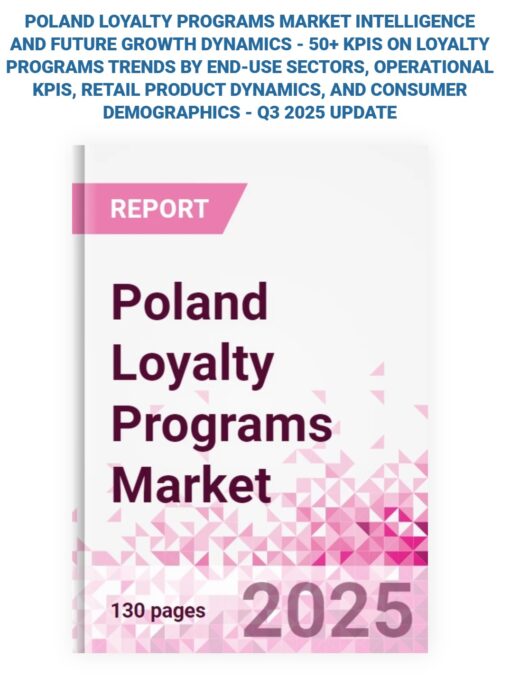
This article is a transcript of a conversation with Jakub Sadowski, editor of Magazyn Wiadomości Handlowe, in which we discussed the current state of the loyalty programme market in Poland. This conversation took place in the context of the release of the report Poland Loyalty Programmes Market Intelligence and Future Growth Dynamics.
1. What is currently the source of success of loyalty programmes (particularly in the context of retail chains)? What elements create the most impact? Are points and discounts sufficient, or is personalisation and user experience becoming crucial?
Re. 1 I highly doubt the certainty in that question: that loyalty programmes are a success for retail chains. The “Loyalty Programmes Monitor” study published in October by the ARC Rynek i Opinia Institute seems to confirm my doubts with much certainty. One of the first questions that respondents are asked is: “In which specific loyalty programme(s) do you participate? It may be helpful to recall which loyalty cards you have or which shop apps you use.” And the level of 10% indications is exceeded by only four programmes, i.e. Moja Biedronka, Lidl Plus, Orlen Vitay and Klub Rossmann. Only four out of 163 (one hundred and sixty-three!) B2C loyalty programmes, i.e. those aimed at end buyers, enjoy a spontaneous level of declared participation above 10%. Moreover, compared to last year, although 12 new loyalty programmes have appeared on the market, the declared level of participation has decreased significantly from 72% a year ago to 66% today. However, since your second question confirms the success thesis, my response is that the points have not been sufficient for many years. Points-based programmes are currently the least represented category in the market. Discounts are offered by all players, the problem is that they are mostly not unique. Anyone can find an equally good one, whether or not they are a participant in the programme in question. And if you can’t find one, you negotiate with the retailer. I agree, however, that hyper-personalisation and user experience are crucial for success. You should also bear in mind that today no B2C loyalty programme can succeed without a perfect mobile app, currently used by almost every participant – 93% to be precise, according to the 2025 Loyalty Programmes Monitor by ARC Rynek i Opinia. For the consumer, a programme equals a mobile app.
2. The Research And Markets report highlights the growing importance of ESG-focused programmes. Do green incentives really translate into a real increase in loyalty, or are they mainly perceived as image-building measures?
Re. 2 I presume you are asking about Poland Loyalty Programmes Market Intelligence and Future Growth Dynamics – 50+ KPIs on Loyalty Programmes Trends by End-Use Sectors, Operational KPIs, Retail Product Dynamics, and Consumer Demographics – Q3 2025 Update. I have not read the results of that report. The official summary of the findings on the Research and Markets website leads to the conclusion that the dynamics of the value increases in the loyalty programme market for 2020–2024 are significantly lower than the official cumulative inflation rate. Therefore, I would say that in inflation-adjusted terms, the market for loyalty programmes is declining, not growing, as the authors claim. Notwithstanding the above, referring to the ESG issue, I can say that ESG orientation is a clear trend in developed markets, especially the US. However, a report by the French-Polish Chamber of Commerce from the end of 2024 shows that half of all companies in Poland do not have an ESG strategy and only half of Polish consumers have encountered the term. Only 25% of Poles have encountered the ESG concept and know what ESG is about. Moreover, the importance of ethics and social responsibility in consumer choices has been showing a slight downward trend for years. Therefore, I do not think that a long-term increase in loyalty based on green incentives is possible. I have found no specific numerical studies in Poland that say, for example, “companies with higher ESG scores have X% higher customer loyalty.” There are a number of reports in the public domain on this issue – mainly from foreign markets; none of the ones I have read cover a representative sample of Poles.
3. Which gamification activities work best and is there a risk of “overplaying” them, i.e. declining engagement, if they become too common?
Re. 3 Gamification in loyalty programmes works well if it combines several key elements. These are, above all, a short time horizon allowing the reward to be obtained relatively quickly, emotional involvement, combined with a form of e-effort usually taking the form of “scratching something on a smartphone screen” or “shaking a phone” or “opening a digital safe”, together with the e-collector mechanisms implemented to collect diverse forms of digital identity cards. It should all be based on behavioural data and be tailored to the participant’s purchasing history. In the case of grocery retail, gamification based on the concept of a family of “plushies” is mandatory, so as to influence buyers through the emotions of their children. If we add to this the valuable prizes given out as part of lotteries for participants in loyalty programmes, with the creative nature of Wheel of Fortune or instant draws, where we find out about the winnings “here and now”, we basically have a recipe for success. The Polish consumer responds best to simple, frequent and emotional stimuli – rewards available immediately, a sense of progression with the action, and the opportunity to compare with others. For wealthy participants and those where the price point of purchase is set high (airlines, exclusive hotel chains, etc.), status gamification works well. I do not think the overplaying risk is present. The same concepts, more or less, have been repeated every year for years, and they continue to deliver the expected results. This is because the next generation of consumers is entering the market, and a nonaffluent (relative to Western European or US markets) society finds elements of agency in this form of entertainment, spending household budgets at those retailers who have understood the importance of gamification well.
4. The subscription model (such as Amazon Prime) is also increasingly visible in grocery retail. Do paid supermarket loyalty programmes have a realistic chance of mass adoption in Poland?
Re. 4 Definitely. First, it is important to realise the prevalence and power of Amazon Prime in the US market. I recently had the opportunity to live in the US and I must admit that my idea of the scale of success of this programme had significantly underestimated what I experienced there. Amazon Prime is widespread and offers a number of benefits in traditional grocery retail as well. In Poland, subscription loyalty programmes are naturally developing first in e-commerce, as a result of its dynamic development and popularity. This is best evidenced by the fact that I have recently read a research report which showed that 40% of respondents cited the presence of a parcel machine in the immediate vicinity as an important element in their choice of housing location. Regarding the question of whether paid loyalty programmes in supermarkets have a realistic chance of mass adoption in Poland, it is important to note that Poles accept the concept of the subscription model and are willing to pay for access to what is not commonly available for free. However, they expect a very concrete return on such an “investment”. Therefore, communication in native subscription programmes is geared towards showing the consumer how much they have already “saved” by subscribing. At the same time, the success of solutions such as Allegro Smart shows that paid memberships can reach critical mass. Can this be translated into stationary trading? In the short term, with a focus on large cities and major chains, I would expect that growth can only happen as a result of cross-promotions with partners for whom this will be part of a wider go-to-market strategy. I can picture loyalty ventures offering shares funded by external partners, giving access to streaming, insurance, innovative payment methods, etc. However, always financed from external sources so as to protect the retail chain’s margins. In addition, it seems that this would primarily be a premium layer of already existing loyalty programmes rather than a “pay to join” built completely from scratch. And ultimately, I find it difficult to imagine that we will see a Costco Wholesale-like concept in Poland within a few years.
5. To what extent will artificial intelligence change loyalty programmes in the next 2–4 years? Will hyper-personalisation be possible without compromising consumer privacy?
Re. 5 Artificial intelligence is already having a huge impact on the way loyalty programmes are managed. Mainly from the organisers’ side, at the level of content creation and data analysis. AI is already enabling the construction of so-called real-time customer microsegments, allowing for accurate offers for every single purchase. From the consumer’s point of view, for now, the main benefit is to even out the previous asymmetry in access to information. The days when corporations had an advantage over consumers through extensive research cells are gone with the arrival of Chat GPT. Nowadays, consumers no longer need to put an effort in analysing. Artificial intelligence will do this for them by comparing offers from different loyalty programmes. More concrete benefits are yet to come, bearing in mind that Jeff Bezos has recently admitted that AI companies are overvalued; however, AI technology itself is “real” and will bring great social benefits, representing a so-called “good bubble”. The issue of consumer privacy is particularly emphasised in Europe. Let this be evidenced by over 15% year-over-year growth in the number of complaints and data breach notifications to the Data Protection Authority. These same consumers, however, have gullibly handed over their biometric data (fingerprints a few years ago and now facial scans) to mobile phone manufacturers, just to use electronic devices and mobile applications seamlessly. It seems that consumers have forgotten or do not realise on a daily basis that if they are not paying for a product, they are the product themselves, and the currency is their time, data and focusing on the screen of an electronic device. Consumer privacy will definitely be violated by AI, but we may not be aware of it.
6. Could cryptocurrency-based rewards, such as cashback in tokens or points redeemable for digital assets, become widespread in Poland? What barriers currently stand in the way of such a model?
Re. 6 I don’t think so. This is mostly because only less than 20% of Polish adults declare they have ever bought a cryptocurrency. Second, because there is no universally accepted cryptocurrency carrier in the market into which this cashback can be paid. Third – though this is perhaps the most important argument – such an action seems to lack justification, or to put it emphatically – sense. Why pay out cashback in Bitcoin, Ether or any of the stablecoins when you can do so in PLN? At the same time, please bear in mind that we are talking at a time when Bitcoin is trading at maximum peaks of USD 114 thousand. When in 2022 Bitcoin cost under USD 17 thousand, no one was asking questions about crypto-based loyalty programmes. In my opinion, it’s a hype that won’t happen on a massive scale in Poland. Notwithstanding the above, it should be noted that some fintechs and trading platforms are introducing micro-cashbacks in tokens.
7. Which type of coalition programme is likely to dominate the market in the future: retail + bank, retail + mobility, or perhaps retail + media/lifestyle?
Re. 7 I think it is useful to start by establishing what a coalition programme actually is and how it differs from others operating in the market, including multipartner programmes. Let us assume that by a coalition programme we mean a loyalty programme in which several independent partners (brands or companies) co-create a common platform for rewarding customers by allowing them to collect and use points, discounts or other benefits with various programme participants, most often using one common card, app or user account. In this context, nothing has changed since 1999, when the first two loyalty programmes in Poland were established. As long as a grocery retailer, petrol station, telecommunications company, bank or payment card operator is in the coalition, success is assured, at least until the partners start quarrelling with each other or come to the conclusion that their interests often conflict with those of the programme operator. Since the period of my professional career coincides with the development of loyalty programmes in Poland, give or take 3 years, I can say without exaggeration that I have seen everything. I will not list specific examples, but suffice it to say that as a nation, we Poles are significantly better at breaking coalitions than building them. In my opinion, no coalition programme will dominate the Polish market, mainly for reasons that I cannot comment on due to a number of signed non-disclosure agreements that bind my organisation and me personally due to the loyalty programmes and consulting projects we manage. Suffice it to say that at i360 we are engaged in coalition ventures involving a bank, a payment card operator and external partners from various market categories. The key to success is always to clearly determine who is responsible for the technology, the sources of funding for such coalitions and the rights of the partners to communicate and monetise the participants. It is worth adding that in the future, coalition programmes may evolve towards Customer Data Platforms (CDPs)
dr Tomasz Makaruk
i360 CEO
Tomasz Makaruk is a co-owner and a CEO of i360, at the same time the author of a blog dedicated to loyalty programmes (www.marketingbusinessblog.pl). i360 is an entity specialized in organizing both B2B and B2C loyalty programmes (www.i360.com.pl), as well as a vendor of software for managing such activities that has been implemented in 16 CEE and Eastern European markets (www.loyaltysoftware.eu).
Warsaw, 28 October 2025
The illustrations used were taken on 30.20.2025 from the website https://www.researchandmarkets.com/reports/5585229/ poland-loyalty-programs-market-intelligence-and?srsltid=AfmBOoojnWZqfSNDbX-WmFhERV3G4U_U07UDS5qyyHG0b0wDqjBeE_Gd
0